Free Resources



Gaming and Simulation Resources
Every step away from the keyboard is a step closer to virtual reality. In this area you will find everything from simply putting shortcuts and triggers on a basic X-keys, to full sized simulation cabs and cockpits using our Switch Interface and Matrix Board devices.
We believe the potential of the X-keys as a game control has yet to be fully realized. If you have a layout you'd like to share for your favorite game or simulation program, please contact us: [email protected]
Flight Simulation
So many of you are using the X-keys in your cockpit simulators, we had to give you guys your own page. Click here (new1flight.php) to go to it.
New X-keys Matrix Board article published in Computer Pilot Magazine by Matt Edwards. Find out how he added switches with the X-keys Matrix Board to build his own cockpit simulator: Cockpit Building Series Adding Switches with the X-keys Matrix
Quake III and Half-Life
Drew Lanclos of SLcentral rates the X-keys for gaming. Thanks, Drew.
Review of X-keys with Quake III and Half-Life: systemlogic.netNascar Racing
Dave Thayer posted this review at Simcyberworld. Thanks, Dave.
Review of X-keys with Nascar Racing: simcyberworld.comTrain Simulation
P.I. Engineering makes the only commercially available train cab controller for Microsoft Train Simulator, Auran Trainz, Trainmaster, and scale model trains. Learn more about RailDriver train cab controllers at this site: raildriver.com
MSTS Route Editor
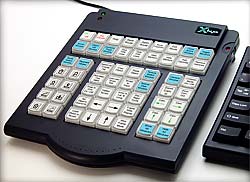
Tim Court designed this X-keys for MSTS Route Editor.
The layout lets you keep one hand on the mouse and the other on the X-keys while your mind stays on your route. We sell this as a pre-programmed X-keys, but we encourage you to reprogram any or all of the keys to fit your style of working. Any key on the X-keys can easily record any sequence or combination of keys from your keyboard. Download the X-keys profile here: MSTS_RE.xk2 . Open it with Macro Maker, and Assign to Device under Macro Maker's File menu to make it active.
BVE
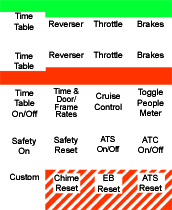
BVE software is free and remarkably realistic. You can download it from the official site: (http://mackoy.cool.ne.jp/).
Here’s an X-keys Desktop control pad Tim Court designed to run BVE, grouping the controls in logical order, so you can sit back in your chair and drive your train.
Using X-keys Matrix Board USB or Switch Interface with toggle and rotary switches
Specifics on installing and wiring our USB Matrix Board are found in the manual manadxfpbus.pdf. Installing and programming our Switch Interface and other X-keys USB devices are covered in the manual manxkusb.pdf. This entire document, including the programming chart, is available here: usbtoggle.pdfWhen programming toggle switches on the Switch Interface or USB Matrix Board be sure the switch you select for programming is toggled on and off before entering your key sequence, and toggled on and off to confirm your sequence before your begin programming the next switch. Watching the indicator LEDs will help; a steady blink means you’re in Programming Mode but no switch has been selected, a double blink means you’re programming a selected switch.
The effect of programming is illustrated in this table and expanded upon in the line-by-line explanation below.
Programming Toggle Switches on X-keys USB Matrix Board
 indicates the “key down” code,
  indicates the “key up” code.
0 indicates a zero state (no keys down or up)
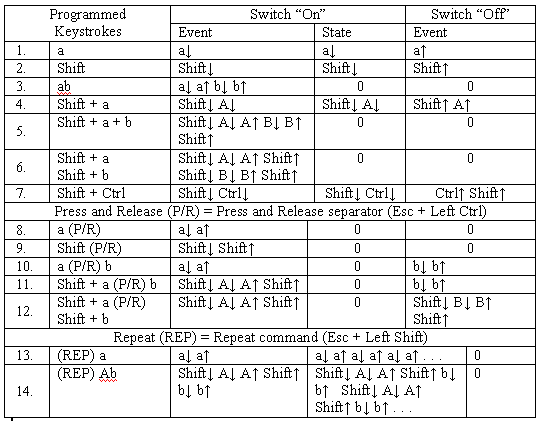
- With a single keystroke programmed, the X-keys sends the “key down” code until the toggle switch is turned off. The repeat rate is determined by the Operating System (adjusted in Windows Control Panel Keyboard Settings).
- Modifier keys (Shift, Ctrl, and Alt) are treated the same way, the X-keys sends a “key down” code until the switch is turned off. Any input from the keyboard or mouse will be “modified” until the switch is turned off.
- With multiple keystrokes, the X-keys sends down and up codes when the switch is turned on, and no additional codes.
- With a modifier key and a single keystroke, the X-keys sends down codes for both keys until the switch is turned off. Any additional input from the keyboard or mouse will also be “modified” until the switch is turned off.
- With a modifier and multiple keystrokes, the X-keys sends down and up codes when the switch is turned on, and no additional codes.
- Multiple modifier and keystroke sequences are treated the same way, the X-keys sends down and up codes when the switch is turned on, and no additional codes.
- Multiple modifiers are treated like single modifiers, the X-keys sends a “key down” code until the switch is turned off. Any input from the keyboard or mouse will be “modified” until the switch is turned off.
- The X-keys “Press and Release” code forces the “key up” code for any keys that precede it.
- The same is true for any combination of modifiers and keys, the X-keys “Press and Release” code forces the “key up” code for any keys that precede it.
- The X-keys “Press and Release” code forces the “key up” code for any keys that precede it, and sends programmed keystrokes/commands when the switch is turned off.
- The same is true for modifiers and combinations. The X-keys “Press and Release” code forces the “key up” code for any keys that precede it, and sends programmed keystrokes/commands when the switch is turned off.
- Same as above
- The “Repeat” code followed by a single keystroke sends multiple down and up commands. The repeat rate is determined by the X-keys Firmware and is independent of the Operating System’s repeat rate (see switch 1).
- If the “Repeat” code is followed by multiple keystrokes they are repeated in order. The repeat rate is determined by the X-keys Firmware and is independent of the Operating System’s repeat rate.
Multiple toggles
With multiple toggle switches, the last switch thrown (on or off) overrides all previous switches. Any switch remaining in the on position will have no effect until it is thrown to the off position. Any switch programmed with separate press and release commands using our Press and Release separator (Esc + Left Ctrl), when toggled off (released), will send its release commands.
Single keystrokes are an exception to this rule. When a switch programmed with a single keystroke is on, the switch will remain in a “down” state until another switch is toggled on, or a switch with multiple keystrokes or commands is toggled off.
A switch programmed with a modifier key (Shift, Ctrl, Alt) will remain in effect until it is toggled off or another switch with multiple keystrokes is toggled on.
Rotary Switches
Rotary switches can be connected to the X-keys Matrix Board by using a single row of the matrix for the common pole and individual columns for the multiple poles. The type of switch (break before make or make before break) may affect your programming. As with toggle switches, the Press and Release separator may be used to force a “key up” code after a single keystroke or modifier (see lines 8-12 in the table above).
Programming a rotary switch provides another unique situation in that our programming sequence requires that you close the same switch once to initiate programming and again to confirm programming. One solution is to leave the switch on an open pole and use a jumper wire to make the connection between the common pole and the selected pole during programming. A second solution, if you project allows it, is to leave every other pole open when you wire the switch.
Accessories | Developer´s Corner | Resources | Support
Shopping Cart | Checkout | Privacy Policy | Site Map
X-keys, Y-mouse, RailDriver and The No Slogan Company are Trademarks of P.I. Engineering, Inc.
Copyright © 2006 P.I. Engineering, Inc. All Rights Reserved.
101 Innovation Parkway
Williamston, MI U.S.A. 48895
1-517-655-5523
FAX: 1-517-655-4926
www.piengineering.com | www.xkeys.com | www.ymouse.com | www.raildriver.com
Visit Our New Divisions: